


Three years ago I started pitching a strange idea: a daily threat intelligence broadcast for decision makers, produced end to end by AI, translating technical intelligence into the language executives actually use. I pitched it to industry professionals and to a VC firm. They passed. Too abstract to fund as a concept.
So I built it.
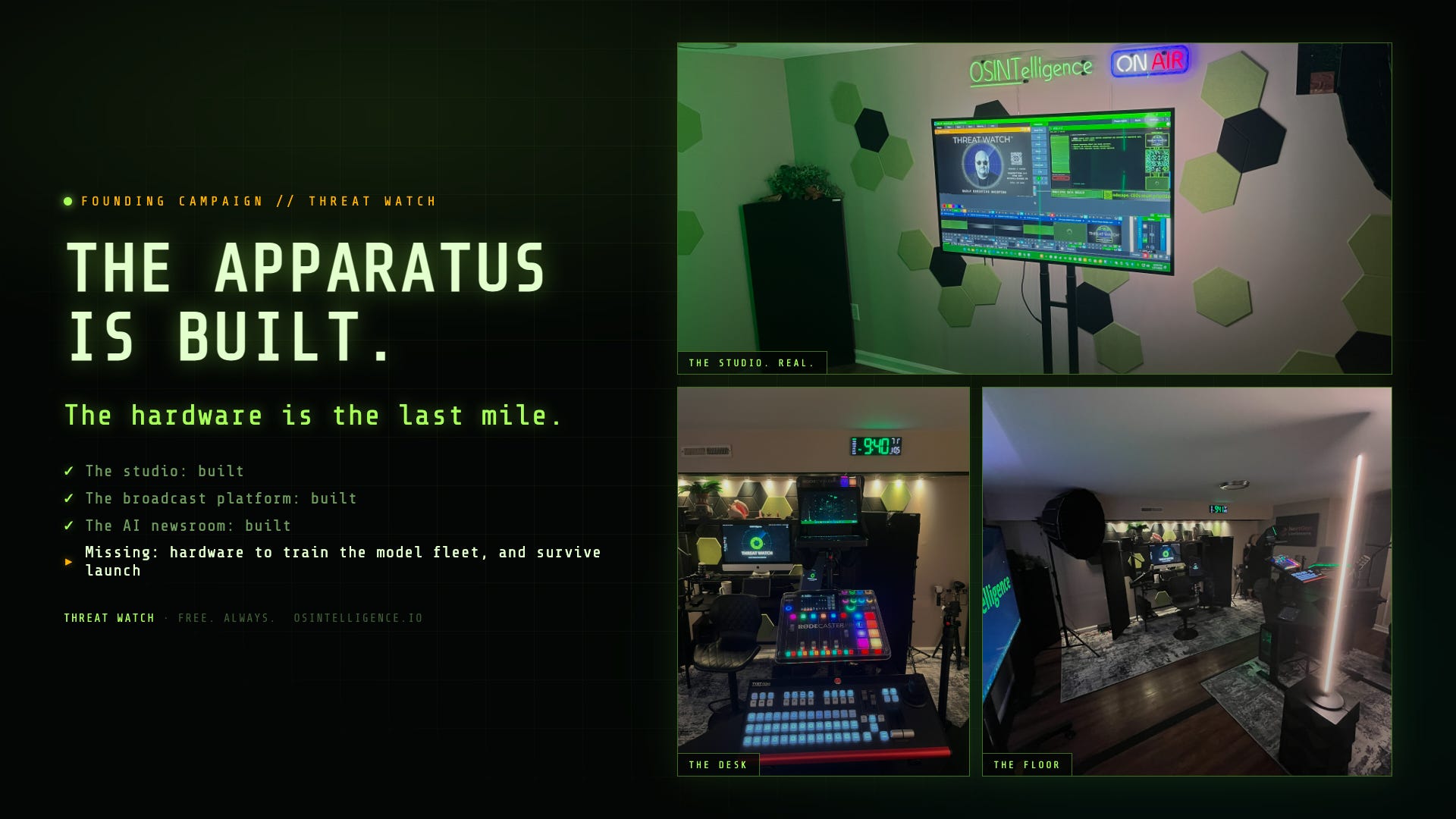
If you have followed this Substack, you have watched it happen. The studio is real: lighting, audio, switching, teleprompter, built from scratch. Behind the studio sits the part photos cannot show: a broadcast platform that renders the show, an AI newsroom that reads hundreds of intelligence feeds and writes, scores, and fact-checks a daily briefing in eight separate passes, and a fleet of local AI models that runs it. The next step is training each crew seat into its own custom specialist, a specially trained model per role, not a prompt.
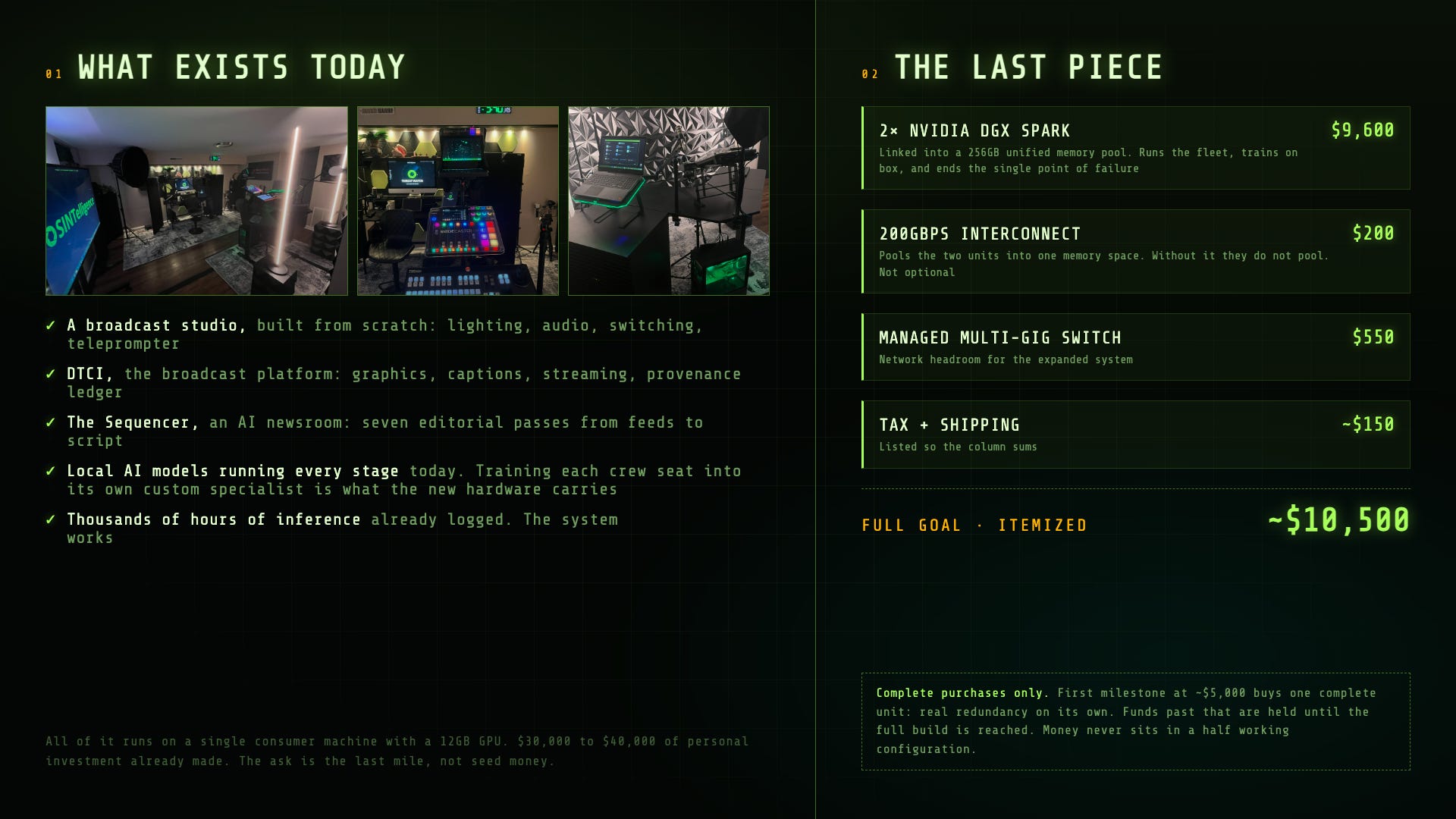
All of it runs on one machine with a 12GB consumer GPU.
This was never just one show
What I have been building is a broadcast network. Here are its first three programs.
Threat Watch Daily. The flagship, and what this campaign funds. Monday through Friday, 7am, about 15 minutes: the day’s threat intelligence translated into business and risk language for executives and decision makers. It is produced fully autonomously inside the AI system, no human in the daily loop, which is exactly why it can hold a daily cadence. Free. It always will be.
A monthly hosted deep-dive show. Once a month I host personally, with expert guests, going deep on the technical side for the analysts and practitioners reading this. This is the show the studio in the photos was built for. For subscribers.
A weekly dossier. A written technical threat summary that falls straight out of the intelligence pipeline. For subscribers, forthcoming: it ships when it is ready.
Where this is going
Here is the part I care about most, and the reason the hardware ask below exists. Every episode and every day’s intelligence, aired or not, banks into one accumulating record. The newsroom already references prior coverage when it writes new stories. As that record deepens, the system stops just reporting days and starts tracking threat campaigns, actors, and trends across months and years. You do not just hear what happened yesterday. You see the campaign it belongs to.
I want to be precise about status: that engine is forthcoming. It needs refinement, and it comes online as the system matures. The daily briefing launches first. The campaign-tracking engine is what the daily briefing is being built toward, and every day the show runs feeds it.
Nobody else sits in this intersection: daily, video, executive-framed, AI-produced threat intelligence. And nobody is turning longitudinal, campaign-tracked threat intelligence into a broadcast. The lane is open.
What it took, honestly
I have put $30,000 to $40,000 of my own money into this over three years, and honestly $40,000 is the safe number. A lot of it is not even itemized: services, software, subscriptions, the room and set build, acoustic treatment, lighting, infrastructure. For reference, having a studio of this caliber commissioned, a multi-camera, hardware-switched, NDI-networked, acoustically treated, professionally lit set, runs $30,000 to $50,000 or more from a systems integrator at current rates, and broadcast equipment prices are up roughly 20 percent since 2023. I did the integration, the set build, and the workflow engineering myself. That labor is most of what that bracket pays for. And the studio has a clear job: it is the home of the monthly hosted show.
The daily show is a different animal. It does not depend on the studio at all. It is produced inside the AI system, and its real cost center is compute. That is where the economics get interesting: a traditional staffed version of a daily briefing operation, an anchor, writers, producers, analysts, plus studio overhead, is an estimated $255,000 to $837,000 or more a year to run. Threat Watch Daily runs at near-zero marginal cost per episode on a one-time build. In a basement.
The honest problem
Launch is the single thing most likely to break the machine everything runs on. A fully autonomous daily broadcast means hours of production every day. On top of that come the training runs that build each crew seat into its own custom model, and the accumulating intelligence record that the campaign-tracking engine grows out of. All of it lands on one machine with a 12GB GPU that has already logged thousands of hours of inference. The data is backed up, but a backup without a machine to run it is just data. One hardware failure and the operation goes dark.
So be clear about what the ask is: this is not studio gear. It is the compute that runs the autonomous daily show and grows the intelligence engine. I am at the finish line, and the last mile is hardware. This is the one time I am asking directly.
What the money buys, itemized
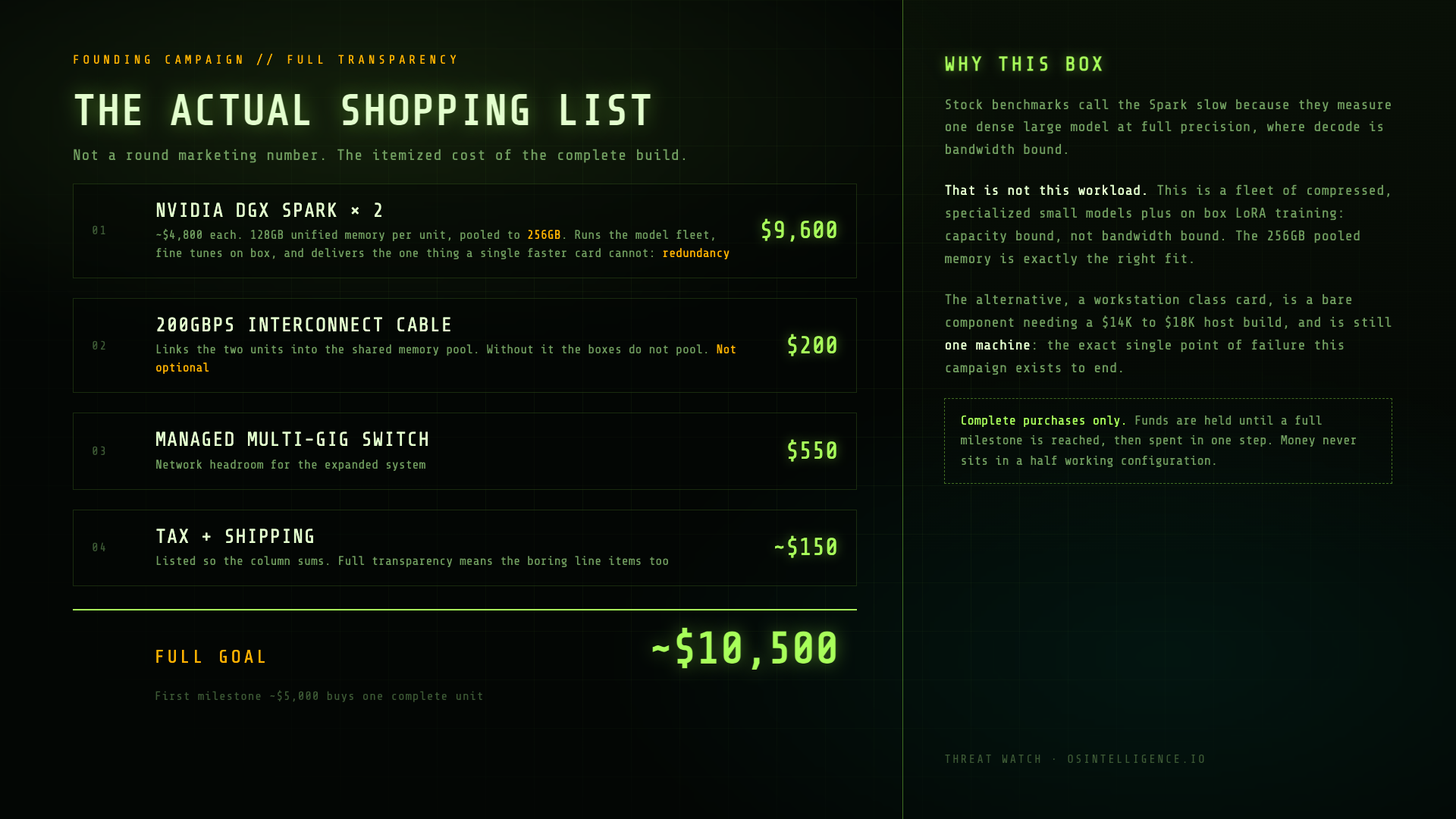
➡️ Two NVIDIA DGX Spark units, about $4,800 each: $9,600. Linked into a 256GB unified memory pool to run the model fleet, fine tune on box, and give the operation a second machine.
➡️ 200Gbps interconnect cable: about $200. It links the two units into the shared pool. Without it they do not pool. It is not optional.
➡️ Managed multi-gig switch: about $550. Network headroom for the expanded system.
➡️ Tax and shipping: about $150. Listed so the numbers add up, because you will check.
Full goal: about $10,500. That is the itemized cost of the complete build, and the column sums to it. Not a round marketing number.
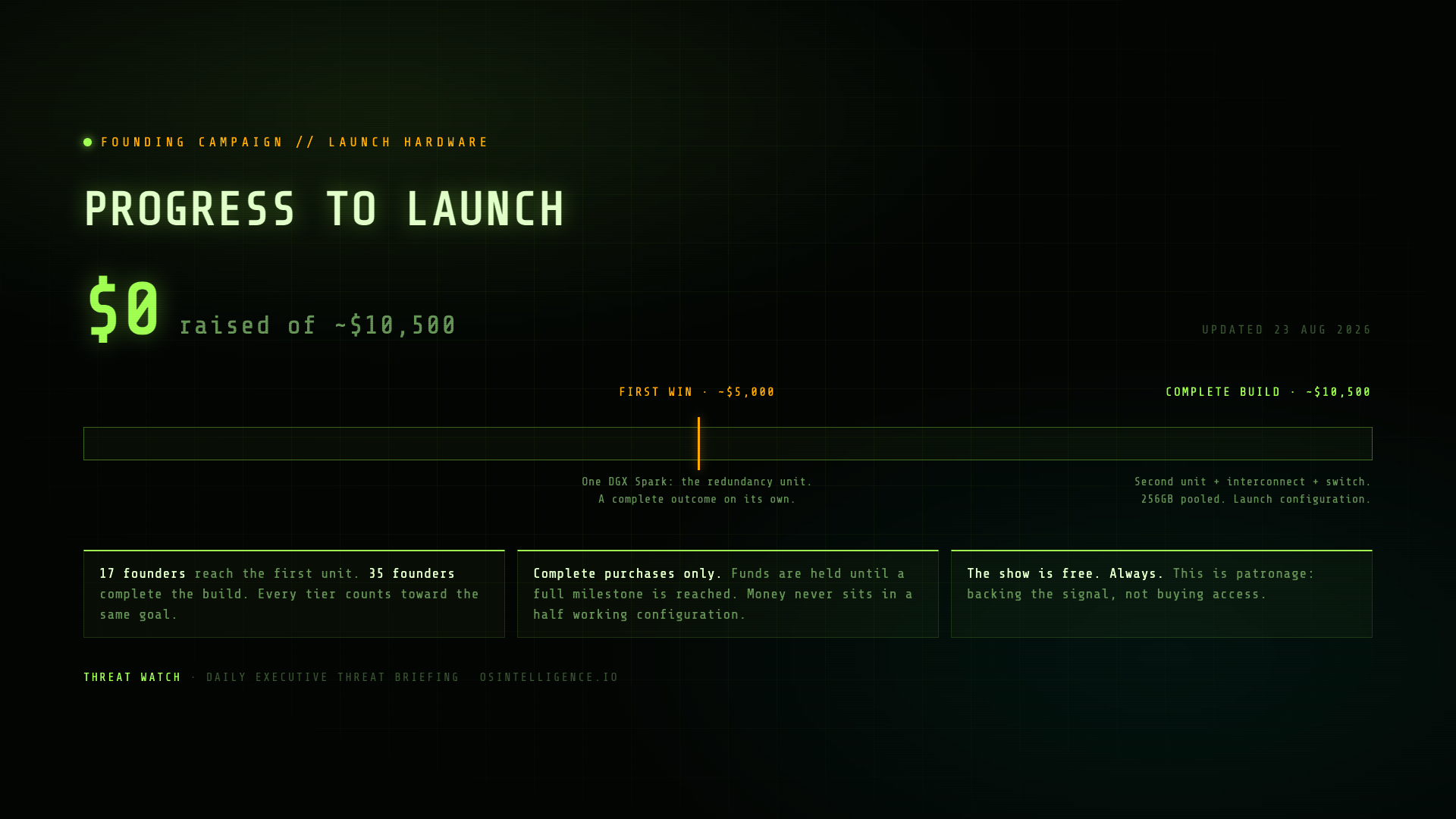
Two milestones. Money never gets stuck in a half build.
➡️ First goal, about $5,000: the redundancy unit. One DGX Spark. This is a complete win on its own. A second machine means the entire operation is no longer one hardware failure away from gone.
➡️ Full goal, about $10,500: the complete build. The second Spark, the interconnect that pools them into 256GB, the switch, and tax and shipping. The full launch configuration.
Funds are applied to complete purchases only. At the first goal, one unit is bought. Funds past that are held until the full goal is reached, then the second unit, interconnect, and switch are purchased as one step. There is never a moment where your money is spent on a half working configuration.
Ways to back it
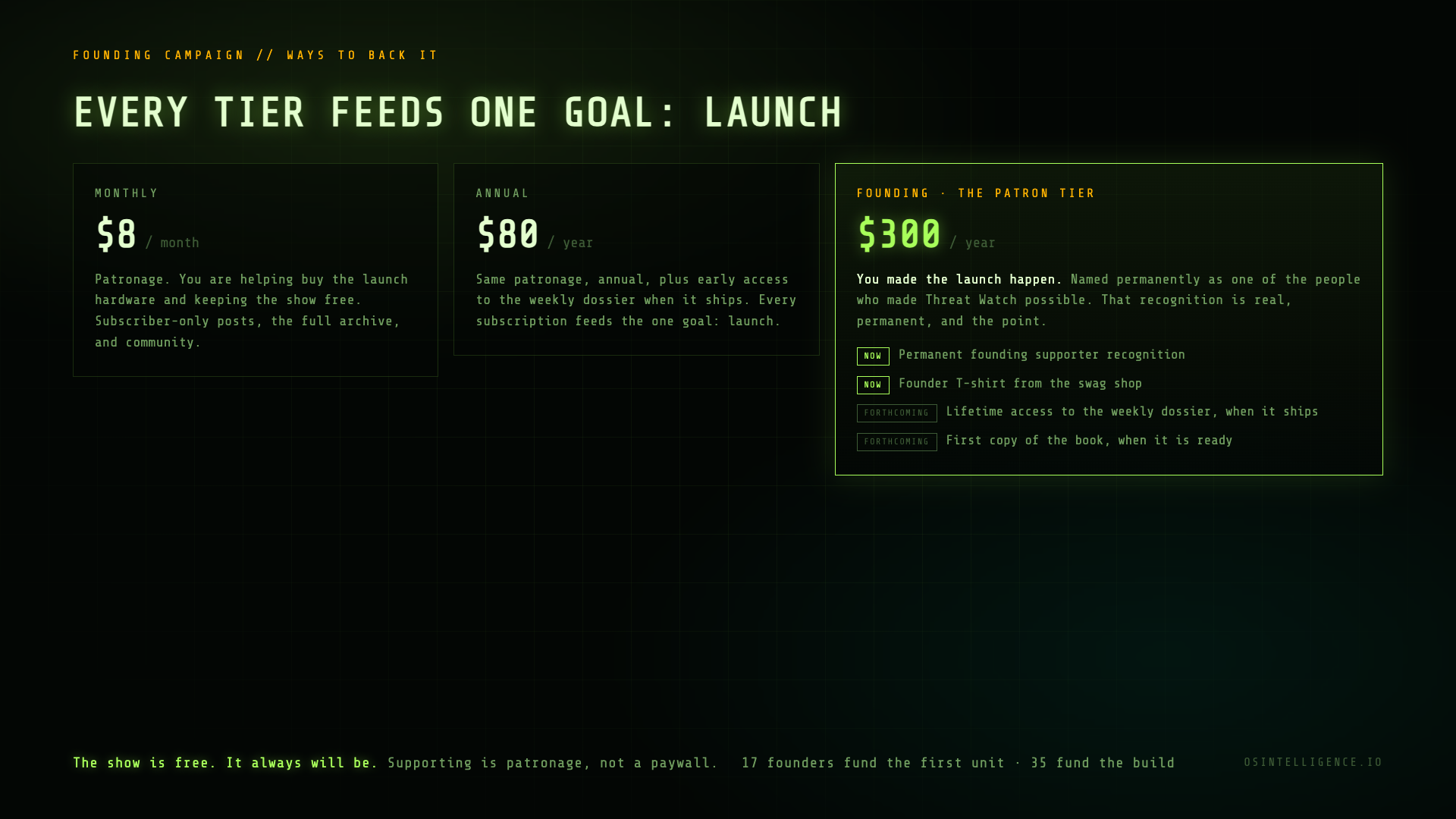
➡️ Monthly, $8/mo or Annual, $80/yr: patronage. You are helping buy the launch hardware and keeping the daily show free. Subscriber-only posts, the full archive, community, and the subscriber programs as they come online: the monthly hosted show and the weekly dossier.
➡️ Founding, $300/yr: the patron tier. A founder is someone who made the launch happen. You are named permanently as one of the people who made Threat Watch possible. The founder T-shirt is available now. Lifetime access to the weekly dossier and the first copy of the book are forthcoming thank-yous: they arrive when they are ready, and I will not pretend otherwise. The book is still being written, so that one is on a book’s timeline.
About 17 founders fund the first unit. About 35 fund the complete build.
The daily show is free. It always will be. Nothing above is a paywall on the daily briefing.
The network
Threat Watch Daily is program one. The monthly hosted show is program two. The dossier is three. More programming follows as the system matures, and further out, a hosted conference. I am not putting dates on those. The network is the horizon. The daily show is the door.
The apparatus is built. Help me cross the last mile.